Author: djjamesmartin

Too Much of a Good Thing?

I’ve never been your average Eurovision fan. 

Consequently, I was probably one of a few people absolutely delighted with a Swedish win in Liverpool for the simple reason that the BBC would be handing over production duties to one of the most competent production houses in the EBU network, that of Sweden’s public broadcaster SVT.

SVT have had a long track record in Eurovision, helping several of the early Eastern European winners in the 2000’s with technical resources but also delivering some memorable contests such as 1985, 2000, 2013 and fan-favourite 2016 where the bar was only really matched by the BBC this year.

One thing SVT has been known for in their past two productions is re-inventing the wheel somewhat.  In 2013 they introduced the producer-decided running order (with countries drawing which halves they participate in.)  This made for a better television viewing experience as you could curate a much better flow of styles, moods, tempos, groups vs. soloists, men vs. women, etc.  The random draw gave juxtapositions no sane producer would otherwise make (such as the UK drawing first in 2012, forcing the show to open with a ballad.)

The caveat to this is that the host broadcaster still must draw their own entry at random (and in the case of proxy hosting, the reigning champions) however I would welcome allowing the host entry to go last after how well this worked on-screen in Liverpool, ending the show with a jubilant local crowd.

Their second innovation came when they hosted three years later, adopting the voting system from their national final Melodifestivalen.  The Jury and Public scores would now be presented separately, meaning that it is only at the last moment that the winner is confirmed.  The system was refined further by Israeli broadcaster KAN in 2019.  In previous contests, a landslide winner meant that it could be mathematically impossible for any other country to overtake them as early as two-thirds of the way though the voting sequence.  This sucked the energy out of the final 20-30 minutes of the programme.

This time round, SVT want to give us a shorter, tighter show.  Rumours of this have abounded for a while, with the returning producer Christer Björkman having confirmed that it is a goal to create a tighter show.
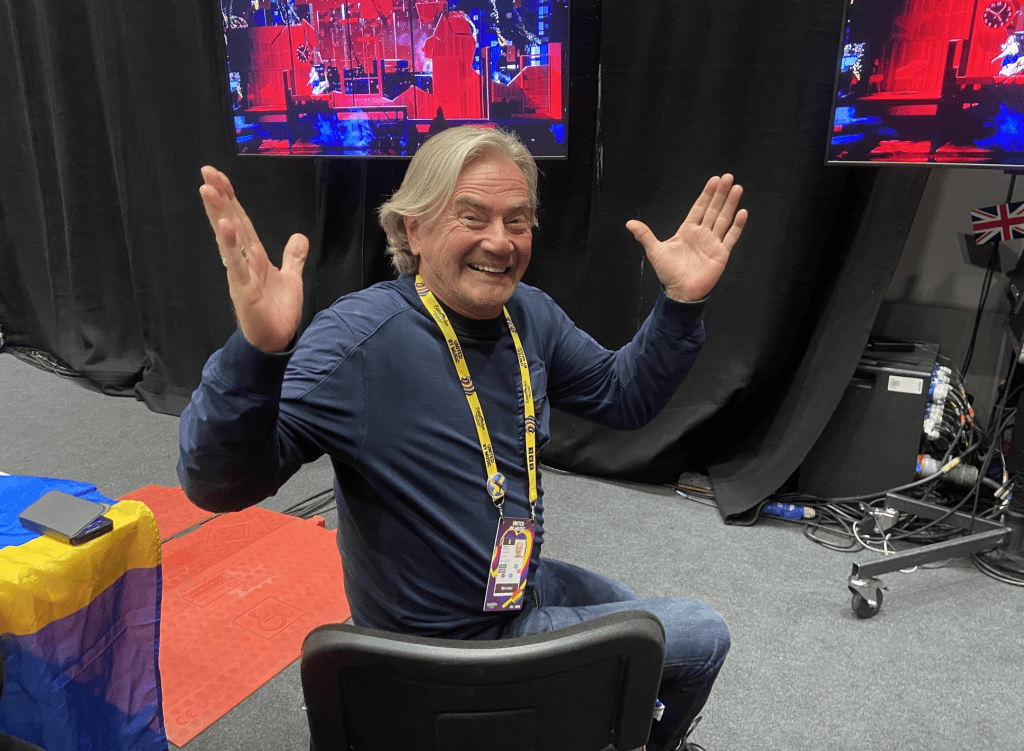
2024’s Head Of Contest, Christer Bjorkman

Some Eurovision fans don’t like this idea and believe the show should be longer than the near 4 hours & 15 minutes marathon the BBC laid on in Liverpool.  I disagree.  A lot of Eurovision fans don’t understand television; a tighter programme is far better for the viewers at home.  Nobody’s saying it needs to be done-and-dusted within the hour, but I do think a 3 hours & 30 minutes final is something SVT and the EBU should both be working towards.

The best bit is, it’s completely possible.

The wonderful ESC Home has a database on the length of various aspects of all 67 productions thus far.  Let’s look at the timings and see if it can be done.

Opening/Flag Parade etc.

Let’s not pretend there isn’t a “Swedophobic” section of Eurovision fans.  These people wish to see the back of the flag parade, another SVT invention (although it was originally done as a one-off by Germany’s ARD back in 1983, which was a very long production for the era.)  I don’t think it’s that much of an issue and it sets the show’s narrative up very nicely.

2013’s Flag Parade

Now, granted, the BBC took until 00:20.14 into the show to begin the first tone of the first song.  That’s only eclipsed by the marathon openings of Lausanne 1989 (where Celine Dion performed both her winning song and her English debut single) and the epic Vienna 2015, which lacked a better editor to be perfectly honest.  In the BBC’s defence, they had to get Ukrainian alumni into the production somehow.

However, Rotterdam 2021 got things going at 00:09.53 including a flag parade, voting info, a “isn’t it nice to be back” and a nice opening film.  That’s the way to do it.  So, I’m saying 10:00 for the opening is enough.

The Songs

One bone of contention recently is the creep-in of complex staging.  Nevertheless, despite the bloat of their 2015 production, Austria’s ORF got through 27 songs in 01:51.31.  It took Italy’s RAI 01:57.35 to get through 25 in Turin last year.  From speaking to delegation members (I stayed with several in my hotel in Liverpool) one senior person described RAI’s organisation as “Quite problematic.”  That said, the BBC took 01:56.45 to get through 26 songs so it would be lazy of me to just blame RAI for typically Italian chaos.  (I have an Italian stepfamily and they’ve not disagreed with me on certain elements of Turin, or indeed RAI’s previous hosting, the infamous Rome 1991.)

This is Holland…

However, it took Portugal’s RTP 01:52.02 to deliver 26 songs In Lisbon in 2018.  Not only was Lisbon a prop-heavy year as the set featured no LED video walls, but the figure also includes Filomena Cautela’s improvised Green Room interviews in the wake of the incident involving the British singer SuRie.  So, I’m prepared to say 01:55.00 is ample time to get 26 songs away.

Remember that the BBC, RAI and RTP timings also include 4 minutes’ worth of preemptable content to allow commercially funded broadcasters to air advertising.

The Interval

This is where the real bloat has come.  ESC Home quotes “duration of interval” as from the end of the last song, to calling up the first country in the voting linkups.

The longest interval ever comes from KAN, who over-ordered on acts whilst the “will-she-won’t-she” game with Madonna was going on.  With Madonna eventually making an appearance (I know, we try to forget) the interval went on 01:04.10.  Rotterdam 2021 is second (00:53.57) then we get onto two of the three shows featuring the most revered interval acts of all time. 

In third place, Stockholm 2016 (Love Love Peace Peace) was a 00:52.06 affair, which also featured a world premiere of Justin Timberlake’s Can’t Stop The Feeling (which unlike Madge gave him a Number 1 all over Europe) new material from outgoing champion Måns Zelmerlöw, a mockumentary called The Nerd Nation and a short film paying homage to Sweden’s pop music heritage since 1974.
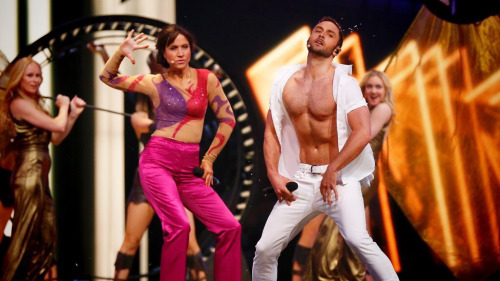
Trust us, make a shorter show. And bring a violin.

In fourth place is this year’s production (Liverpool Songbook) at 00:51.46.  Whilst this was a particularly long feature, the BBC also included Graham Norton interviewing Harrogate 1982 host Jan Leeming, Juilia Sanina chatting with displaced Ukrainians, a film about the voting sequence by Ukrainian commentator Timur Myroshnychenko, and new material from the outgoing British runner-up Sam Ryder.

One of the big issues in the interval currently is the need for three recaps.  We don’t need them.  Two will do, as it does in the semi finals.  Lose one, and you’ve clawed back 6 or 7 minutes (2016 was the last to feature two recaps; SVT simply delivered more content in that window with KAN/NOS/BBC having at least a third of their intervals being taken up by the three recaps.)

Kyiv 2017 is the shortest interval of the “split result” era at 00:41.32, but the first to introduce a third recap. 

The 2013 production in next year’s host city, Malmö, had merely a 00:37.40 interval.  That included two recaps, a song-and-dance routine from host Petra Mede, Loreen performing new material, a film on the history of the competition and even Sarah Dawn “Lynda Woodruff” Finer doing an ABBA cover as herself.  Oh, and we had a short chat with the 2011 Swedish contestant, the popular Eric Saade.  Even then, I reckon that’s boilable down to the half-an-hour or so in Oslo 2010 (00:30.39) or Baku (00:30.29).

The interval currently includes one advertising window of 8 minutes.  Whilst the BBC avoided putting anything particularly interesting in this section, the decision to load it with dispensable filler slowed down what was otherwise a slick, if long, production in my opinion – especially as domestic viewers don’t leave the world feed for advertising.

RAI were smart with this and split the 8-minute windows into two, with a guest performance in the first 4 minutes, then a short “opt out now” sting followed by 4 minutes of filler; so, if broadcasters didn’t need all 8 minutes (very few of them actually do) then they could still air the guest performance and get the adverts away, which was how Italian viewers saw the Turin show.  I’m surprised the BBC didn’t try this, with Sam Ryder in the first half, before the displaced Ukrainians and a VT in the second.

The Voting

The post-2016 split system, refined in 2019, does limit comparable productions but the shortest of these under the current system was, in fact, the debut: Tel Aviv 2019 delivered the voting in 00:49.44.  So, I’m saying 50:00 for the voting.
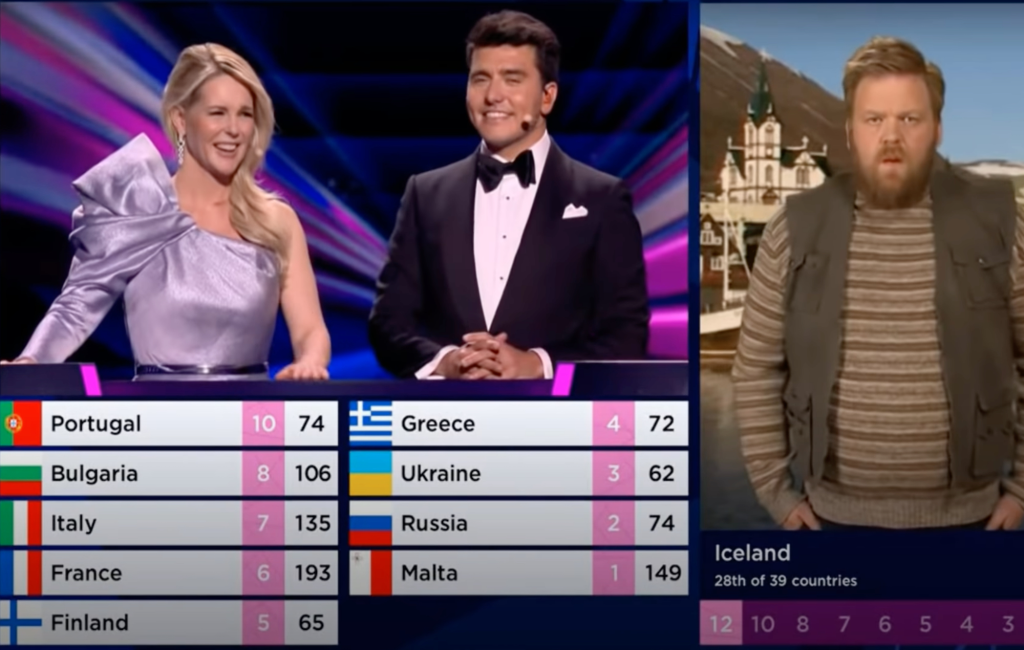
Play Ja Ja Ding Dong!

The voting windows currently include one advertising window of 2 minutes.

Due to the way ESC Home calculates timings, for the avoidance of doubt the closing of the lines and the “Good to Go” are considered part of the interval.

I don’t think realistically you can get the winner’s walk down too much, although the BBC approach of having the international presenters say nothing, instead leaving an instrumental window for the commentators to reveal where the viewers gave their public points and sum up the night, made for a much better production than hearing the hosts find 78 ways to say “the winner is Loreen from Sweden!”

That leaves us something a bit like this (all times BST.)

  • 20:00    Te Deum / Opening / Flag Parade
  • 20:10    SONGS (including 2 x 2min ad break)
  • 22:05    Interval (2 recaps only + 8 min ad break)
  • 22:35    Voting (including 2min ad break)
  • 23:25    Winner’s Walk + Interview
  • 23:30    Reprise / Credits
  • 23:33    OFF AIR

What do you think? Is a tighter show better for us all, or does quantity bring quality? Let me know your thoughts.
TaP Out!

So, TaP Music have ended their two-year relationship with the BBC.

In a statement, the label said:

It’s been brilliant working with the BBC for the last two years, but for now, we think it is time to pass the baton back. We wish the BBC the best of luck with ongoing success and continuing to build the excitement and audience [for the Contest] in the UK.

The news isn’t entirely unexpected, since TaP only ever agreed to sign on for one year, Turin 2022. However, after Sam Ryder exceeded all expectations and the UK won the right to host by coming second to war-torn champions Ukraine, they agreed to do one more year.

Unfortunately, I think that’s where things went wrong.

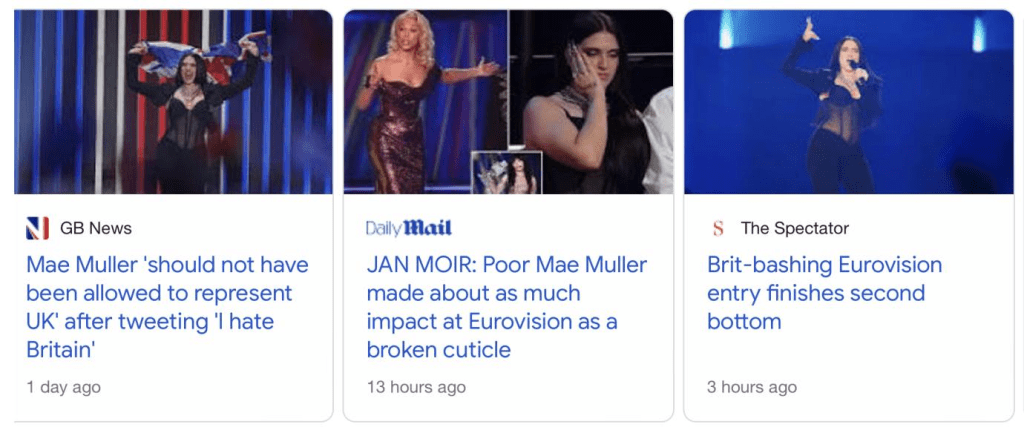
Mae: Mullered

I’m going to get straight to the point: I don’t like Mae Muller as a person.

I’m in no doubt that someone will be straight along to say “It’s only because she said things about the Tories and Boris Johnson you didn’t agree with” but it goes deeper than that. It even goes deeper than saying someone doesn’t deserve NHS medical care (former PM Boris Johnson, very poorly with COVID-19 in Spring 2020.) Muller’s attitude disalayed a complete lack of media training or due dillegence.

But nevertheless, even if you do agree with Muller’s sentiments – and I know 9 in 10 of you do (which is fine, but please GTFO and vote next year, no matter how much I disagree with you!) – the former PM is still held in high regard across Europe because of his support for Ukraine. They don’t care about Partygate and all our internal dramas, because they have their own fish to fry.

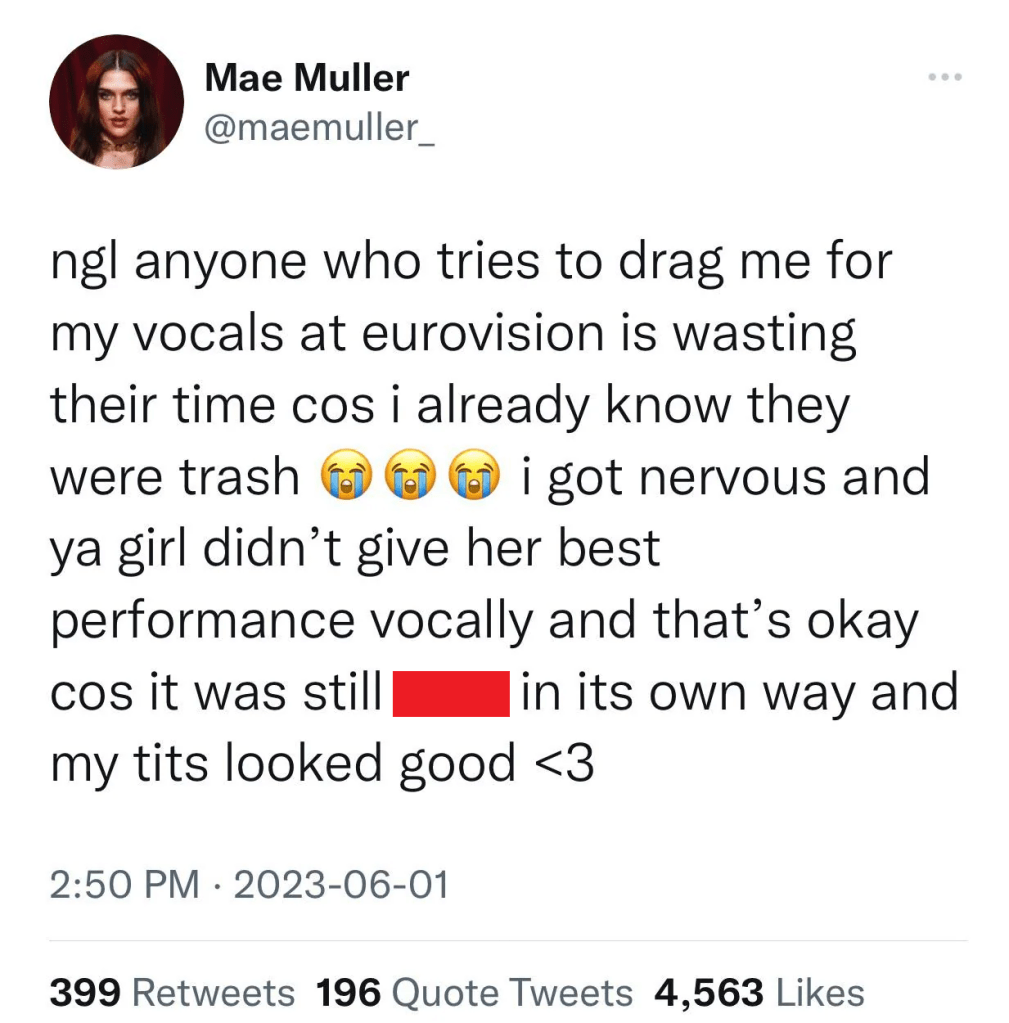
But even without the politics, her whole personality on what we now know as X, the main platform she uses to promote herself, just came across as very unpleasant. I’ve no doubt Sam Ryder is no Tory, but he’s smart enough an operator to keep his powder dry and his kind, compassionate, unrelenting positivity was a breath of fresh air. Muller always felt like she she was on the attack, on the defensive. I feel that put some people off her, and a bizarre rant on X a few weeks after the Contest highlighted that.

Again, this just screams “lack of media training.” A better trainer would have done a search for any potential skeletons and had the offending content deleted. Indeed, Molly Smitten-Downes’ personal Facebook and Twitter feeds were removed of all content the night before the BBC unveiled her as the entrant for Copenhagen 2014.

But the other issue was her lack of technical ability. From the first pre-party in Barcelona, there were red flags over her vocals and I have to be honest, I ignored most of them as I wasn’t there physically and felt unable to comment. The first time I heard I Wrote A Song performed in person was at the taping of the Semi Final 2 preview during that heat’s Jury Final Evening Preview. You know this is being taped for the 60 second preview during the Big 5 Chat and you need to bring your “A” Game.

Now, on that same evening in Turin a year earlier was when anyone who watched Sam Ryder’s taping of SPACE MAN knew it was the moment we went from “left of the board, finally” to “s**t, we might get Top 5!” Unfortunately it was at that moment my heart sank at any hopes of what I inititally hoped could muster a Top 10. It’s a shame, because the staging was perfect as it was in Turin (and, indeed as it was for Freya Skye at the Junior Contest in Yerevan) – there is no doubt the lessons from Embers, which was (justifiably) described on The Euro Trip Podcast as “embarassing” this week, have been learnt in that regard.

Why Does This Matter?

It was suggested on The Euro Trip, but I happen to agree with it. Would TaP have stayed on had Muller not failed in Liverpool? There’s two schools of thought; one is that TaP only signed on for one year originally, only agreeing to stay on because of a home Contest. The other is that after the epic turnaround in Turin, to go back to square one on home turf must have been galling in the extreme.

But I’m not convinced either we or the BBC need TaP anyway. They scored one spectacular success and one spectacular failure. However, they’re not the only show in town. Freya Skye and Lose My Head at the Junior Eurovision Song Contest 2022 in Yerevan were discovered and staged without any TaP involvement and the result was a televote win, coming 5th overall; a result we would have killed for in Liverpool and a song we would have killed for at the adult show in the 2010’s.

What About A National Final?

This question is a bit trickier.

Firstly, I don’t think there is either the public or record industry appetite to even try and import the Melodifestivalen format lock, stock and barrell from SVT in Sweden. Anyone who has attended the final in Stockholm (and I urge every Eurofan to go at least once) knows there is a big disconnect between the profile of the local Swedish audience and the audience who attended Eurovision: You Decide in the late 2010’s in the UK.

At Melodifestivalen, entire families go. Mum, Dad and the kids all make the pilgrimage. Right from the moment I got off the plane at Arlanda on the escalator down to the train station I met a mother and her 10 year-old daughter who was carrying a glittery home-made sign, nearly as big as she was, proudly displaying the words “Klara Hammarström” in support of her favourite singer, competing with the song Queen Of Kings Run To The Hills.

Assuming the mother would, like all Swedes, speak better English than the Brits do I teased her about me being Team Cornelia and we struck up a lovely chat; she could simply not belive a Brit had flown in to watch their National Final!

In the hotel, which was next to the Friends Arena, I sat drinking coffee in the lobby on the Saturday afternoon people watching (and also getting a very kind hotel staff member to print off my COVID-19 paperwork, still required at that point to let me back into the UK the next day!) and amongst the mix of dancers and SVT technical crews were, again, entire families. The kids, especially the girls but the boys too, all wore their glitteriest party frocks we all had when we were that age. Even the Mums wore glittery hats!

But that’s all because Melodifestivalen is such a big deal in Sweden. It is, literally, Sweden’s Super Bowl. It is a fantastic production, done as only SVT can do (you think the BBC nailed production this year? You ain’t seen nothing yet.) Furthermore, Eurovision is a religion in Sweden. If we don’t take it seriously enough, they take it too seriously and that’s been reflected in their record-equalling seven wins.

We just don’t have that relationship with Eurovision in the UK, where the National Finals, when we had them, were attended by the same demographic who attend the actual show in May itself which is mostly gay men. There is no problem with this. NONE. But that’s the way it is; attending Eurovision or a National Final is not considered the “family” event in the UK that it is in Sweden. Eurovision is a One Night Only affair on this island. Greatest Hits, You Decide, Come Together, Shine A Light and even the BBC’s debut at JESC all underperformed in the BARB Ratings on BBC One.

The semi finals might have been on BBC One this year but even then a Spring series of I’m A Celebrity beat them by a ratio of 2:1. Yet ITV cleared their schedules on the night of the Grand Final, knowing they’d get wiped out if they even tried to put Britain’s Got Talent up against it. Eurovision in the UK is a Once-A-Year Day, as the old song goes. Nothing more, nothing less.

But Is There Another Way?

I believe yes, there is; and the answer is staring us in the face.

Whilst everyone looks to Sweden as the Gold Standard of National Finals, I think actually what Spain are doing could be more easily translated to the UK market. Rather than Benidorm Fest, what about…

LIVERPOOL FEST?

What a fantastic legacy it would be to hold an annual, one night competion broadcast live on a Saturday night from the M&S Bank Arena, aired on BBC One. Obviously it would need simpler staging that could be set and struck with the speed of, say, Sports Personality Of The Year which has also been arena-based at times. However, there’s an entire graphics package that is, pardon the pun, good to go.

Finding the artists and the songs is the tricky bit, especially with the BBC taking a flame gun to BBC Introducing as part of the continuing hot mess that are the batshit reforms going on at Local Radio. However, I’ve no doubt that the Liverpool Institute of Performing Arts (LIPA) would jump at the chance to be involved after they provided dancers to the BBC production this year, both as part of the opening and interval acts as well as the stand-in rehearsals.

The real question is whether or not the BBC have the willpower and more importantly the long-term staying power to try and establish it? There is no doubt in my mind that it would work and get the audience figures if it was properly promoted. Strictly Come Dancing doesn’t have anything like the flashy production The X Factor (a franchise that has hugely influenced Eurovison’s evolution as a television production) had at is peak and I’d even go as far to say SCD is one of the weaker iterations of the entire Dancing With The Stars franchise. But people come week-in, week-out to watch what is, basically, ballroom dancing because they’re told they need to watch it. On TV, on Radio, on iPlayer, the public are bashed over the head with it because it’s advertised as must-see TV.

If the promo and effort for SCD was given to Liverpool Fest, and the high production values they applied to Eurovision were proportionally ported over to the new show (I know they won’t have the same budget, but look at how SVT still make Melodifestivalen a better production than a lot of actual Eurovisions!) I have no doubt it could be the start of a great new era for the UK at Eurovision.

The only thing we need to remember is that, in the words of a certain famous Scouser, “It’s gonna take time. A whole lot of precious time. It’s gonna patience and time to do it right, child.”